Astronomers find strongest evidence yet that Betelgeuse has a companion
29 July 2026
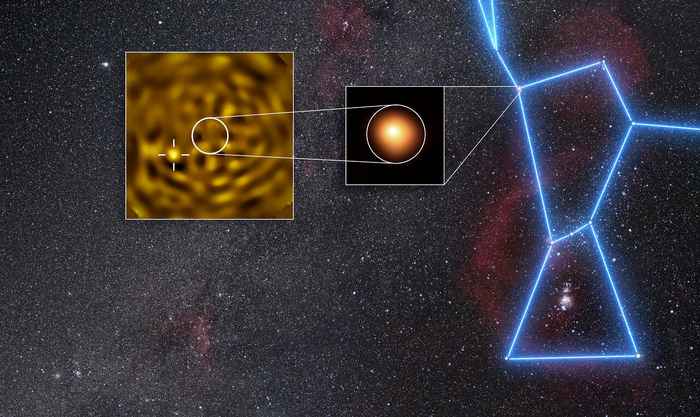
“We have shown that Betelgeuse is accompanied by a faint companion,” says lead author Miguel Montargès (Paris Observatory (PSL), France). “This marks the conclusion of a century-long search.” To be absolutely certain, the team will also observe the companion on the other side of Betelgeuse in a year’s time.
Betelgeuse is a so-called red supergiant in the constellation Orion, easily visible to the naked eye, and has been a favourite research subject for astronomers for many years. One of its most striking characteristics, apart from its red colour, is its variation in brightness. “Observations of this have been made for around a hundred years,” says co-author Alex de Koter (University of Amsterdam and KU Leuven). “The big mystery is: what causes these variations in brightness?”
Possible explanations for the changes in brightness include convection – whereby hot material rises and cooled material sinks – and pulsations of the star. In addition, there could be a companion star orbiting Betelgeuse, thereby affecting the light emitted in our direction. So far, no such companion has been found, partly due to Betelgeuse’s great brightness. If such a companion were indeed to exist, earlier studies suggest it should be most easily observable in late 2024, as that is when, as seen from Earth, it would be at its furthest point from Betelgeuse in its orbit.
Montargès and his colleagues seized this opportunity and observed the star with the VLT in December 2024, before spending several months processing the data. And with success: “I jumped out of my chair when I saw the processed images,” Montargès recalls. “To be honest, I hadn’t expected the VLT to be able to detect Betelgeuse B at its predicted position,” he explains. “But because the star turned out to be more massive – and therefore brighter – than predicted, we managed it after all!”
Strongest evidence
Betelgeuse B has been directly imaged using the SPHERE instrument, which was partly developed in the Netherlands. Although there were already indications of the existence of this companion star, including a possible direct observation with the Gemini North telescope in Hawaii (USA), this is the strongest evidence for, and the clearest image to date of, Betelgeuse B.
“It is remarkable to see how SPHERE, which was originally developed for detecting exoplanets, also performs exceptionally well in detecting a companion star orbiting a massive, evolved star such as Betelgeuse,” says co-author Anthony Boccaletti (Paris Observatory).
Supernova
A few years ago, Betelgeuse caught the attention of both professional and amateur astronomers when the star visibly dimmed. As an evolved supergiant, Betelgeuse is expected to eventually explode in a supernova. The star’s temporary dimming led some to suspect at the time that it was on the verge of exploding. A group of astronomers led by Montargès then studied Betelgeuse using ESO’s VLT and determined that it was in fact being obscured by a cloud of dust.
“Understanding the processes that contribute to Betelgeuse’s brightness variations, such as those caused by its companion, is very important,” says Alex de Koter. “It enables us to better recognise if something unusual is suddenly happening to the light. Strange behaviour from the star could potentially be a precursor to a supernova explosion. And when that happens, believe me, it’ll be spectacular!”