The Netherlands joins the Cherenkov Telescope Array Observatory as observer
30 July 2026
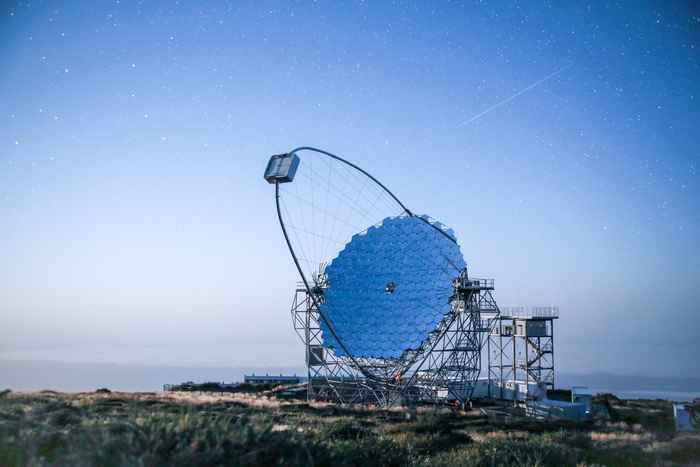
“The Netherlands is pleased to join the CTAO ERIC as an observer; this is an important milestone for our scientists who have contributed since the start of the project in 2007,” says Saskia Matheussen, member of the Netherlands Organisation for Scientific Research (NWO), who will represent the Netherlands on the CTAO ERIC Council.
The existing Dutch support is now being continued in the current construction phase, bringing the combined past and ongoing contributions to approximately three million euros. Supported by NWO and NOVA grants, the Netherlands is supplying hardware for the Medium-Sized Telescopes (MSTs) and co-producing more than 37 cameras for the Small-Sized Telescopes (SSTs).
For the latter telescopes, the Dutch team is responsible for the assembly of the so-called focal plane arrays, the coordination of the software, and the testing, calibration, and commissioning of the cameras. In 2021, Jacco Vink (University of Amsterdam) received a ‘NWO-groot’ grant of 1.5 million euros. With this grant and additional support from NOVA, the Netherlands is developing and producing highly specialized cameras for CTAO.
In search of faint blue flashes of light
CTAO is designed to detect very high-energy gamma radiation released during the most violent events in the universe. Gamma radiation, for example, originates from the immediate vicinity of neutron stars and black holes. The observatory will detect this radiation with unprecedented accuracy and precision, leaving current gamma-ray telescopes far behind in this respect.
When an energetic gamma particle enters Earth's atmosphere, it produces a cascade of particles that cause so-called Cherenkov radiation – a faint but characteristic blue flash of light. This flash lasts only a few billionths of a second and is therefore captured by telescopes that can ‘collect’ a lot of light and have super-fast and sensitive cameras.
Moreover, because Cherenkov radiation is relatively faint, the telescopes are installed in two of the darkest places on Earth. CTAO-North will become part of the Roque de los Muchachos Observatory on the Canary Island of La Palma (Spain), while CTAO-South will be located at the Paranal Observatory in the Atacama Desert (Northern Chile).
Technical and scientific expertise
Dutch team members Vink and Sera Markoff from the University of Amsterdam have received various grants for the CTAO project and have dedicated themselves to increasing interest within the Dutch scientific community. Manuela Vecchi and Andrey Baryshev (University of Groningen) joined them. “Sera Markoff and I have been committed to CTAO right from the very first plans. In 2007, we organized the first astrophysics meeting for the project. It is fantastic to see, almost twenty years later, how the observatory is taking shape and how data from the first telescopes are starting to flow in,” says Vink.
Initially, the Netherlands has observer status for a period of three years. Stuart McMuldroch, Director General of CTAO ERIC, says: “The Netherlands brings invaluable technical and scientific expertise to CTAO. This participation strengthens our collaboration and ensures that their insights continue to shape the future of the world’s leading gamma-ray observatory.”