First microblazar produces possibly the fastest particles in the Milky Way
22 September 2026
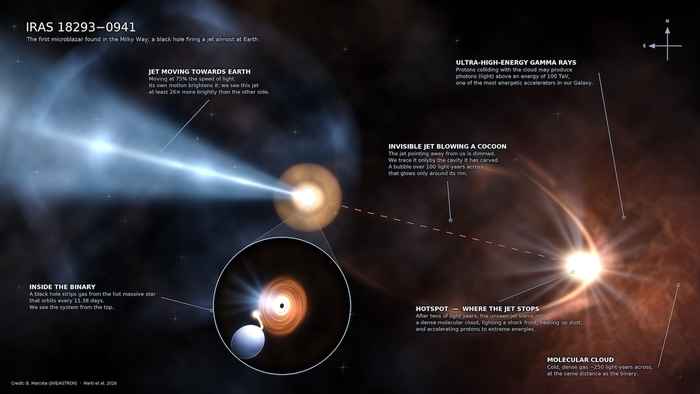
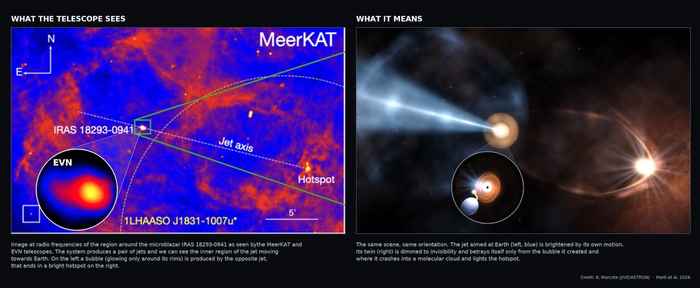
Black holes can attract matter from their surroundings, ultimately producing jets of matter and radiation that escape from their poles at extremely high energies. When such a jet is pointed toward Earth, the object appears much brighter. These types of objects—known as "blazars"—have long been studied in the context of supermassive black holes, which reside at the centers of many galaxies. Now, for the first time, astronomers have identified a stellar-mass black hole in the Milky Way with a jet pointed at Earth. This marks the first discovery of a "microblazar."
Radio observations have revealed not only the jet itself but also its interaction with the surrounding environment. The jet first traverses a region spanning approximately 100 light-years, where it has already "cleared out" the interstellar medium. It then collides with a relatively dense molecular cloud composed primarily of molecular hydrogen and dust. This interaction creates a bright spot on the cloud where interstellar material is ionized and dust is heated. Here, particles are accelerated to nearly the speed of light, reaching energies in the peta-electronvolt range. This makes the microblazar one of the most powerful particle accelerators in the Milky Way—roughly 100 times more powerful than the Large Hadron Collider, the most powerful particle accelerator on Earth.
The existence of microblazars has been predicted for some thirty years. This discovery not only sheds new light on the origin of the most energetic particles in the Milky Way but also provides astronomers with greater insight into similar, albeit larger, systems in other galaxies. “Thanks to this discovery, we can study distant blazars, which are formed by distant supermassive black holes,” says Benito Marcote, senior support scientist at ASTRON and JIVE and one of the paper’s authors. “Those blazars are too far away to image in detail. Because we now have a similar object in our own galaxy, we can study its physics in detail.”
Black hole and massive star
The object—IRAS 18293−0941—consists of a black hole with a mass about ten times that of our Sun and a hot, massive star orbiting each other every eleven days. The jets are created by matter that the black hole strips from the star. This matter first accumulates in a disk around the black hole. Just before the matter finally falls into the black hole, a portion of it is ejected via powerful jets from both of the black hole's poles.
IRAS 18293−0941 was first observed back in 1983 by the Dutch-American IRAS satellite. Astronomers became interested in the object because multiple radio observations revealed a bright, compact core that emitted radio waves from only one side. This indicated the presence of such a jet.
An extensive observational campaign was launched, utilizing radio telescopes (for high-resolution images and visualizing jet interactions), optical telescopes (for spectra and velocity measurements within the system), X-ray and gamma-ray telescopes (to investigate the hot plasma surrounding the black hole), and infrared imaging (revealing the warm dust around the system). “This was truly a multi-wavelength observational campaign,” says Marcote.
Elusive particles
Earth-based cosmic-ray observatories have detected cosmic particles with energies reaching the peta-electronvolt range, yet the origin of these high-energy particles has remained unclear for over a century. One possible source is the shock wave generated when a powerful jet from a black hole collides with the interstellar medium, as observed in this microblazar. In this study, scientists discovered that a bright spot within the molecular cloud coincides with gamma-ray emission capable of being produced by high-energy particles.
Marcote is excited that this microblazar can be linked to this elusive class of particles. “We plan to conduct further observations of the site where the jet impacts the interstellar medium,” says Marcote. “Gaining a better understanding of the processes at play here—such as how the material is heated and ionized—would have implications for our insight into star formation within galaxies, as this process occurs in these types of molecular clouds. We will also learn about the influence microblazars have on the structure and evolution of galaxies like the Milky Way.”
“This discovery demonstrates the power of studying the universe simultaneously using different types of telescopes. No single telescope could have told the whole story,” says co-author Jakob van den Eijnden (University of Amsterdam). “It is a wonderful example of the international collaboration that lies at the heart of modern astronomy".