Most distant fast radio burst to date offers clues about the origin of these mysterious bursts
8 October 2026
Fast radio bursts were discovered in 2007, yet their origin remains unclear. These enigmatic bursts of radio waves last only milliseconds, and the vast majority are never detected again. However, it is clear that many of these bursts originate deep within the universe.
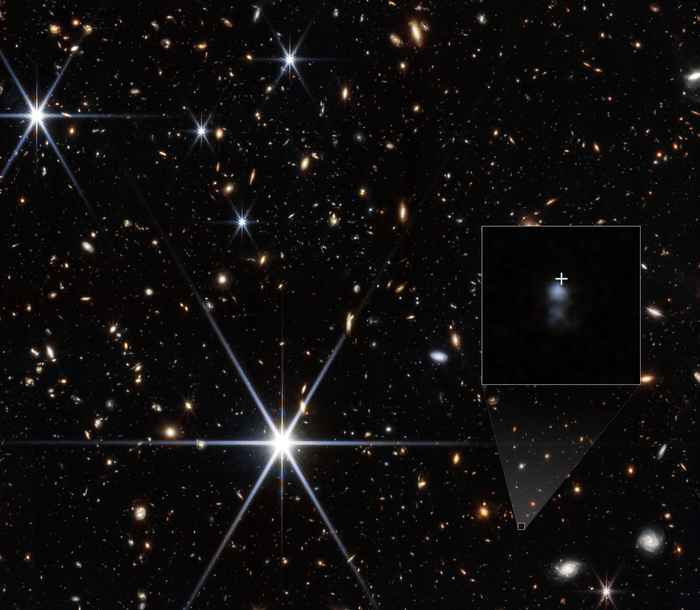
Astronomers have now pinpointed the galaxy that served as the source of the most distant fast radio burst observed to date. Images from the James Webb Space Telescope reveal that the source is a relatively small, young galaxy from the early universe.
This discovery has implications for theories regarding the events responsible for these bursts. It turns out there is relatively little time between the period when galaxies form stars and the moment they become capable of producing fast radio bursts. This suggests that the bursts are caused by young, highly magnetic neutron stars, known as magnetars.
Galactic Lightweight
On March 4, 2024, the MeerKAT radio telescope in South Africa detected the fast radio burst, designated FRB 20240304B. Radio observations indicated that the burst originated at a great distance. To confirm this distance, astronomers used the Webb telescope to observe the galaxy located at that specific point in the sky. With a redshift of 2.1, the galaxy was found to have existed just 3 billion years after the Big Bang. The majority of all fast radio bursts observed to date occurred billions of years later
The host galaxy of FRB 20240304B differs from other galaxies where fast radio bursts have been detected. While most cases involve massive galaxies with high rates of new star formation, this instance involves a galactic lightweight; it is 1,000 times less massive than expected. “We were surprised by the associated galaxy. Instead of a large, mature spiral galaxy, it was a young dwarf galaxy actively forming new stars,” says co-author Inés Pastor-Marazuela of the Anton Pannekoek Institute at the University of Amsterdam and ASTRON.
Magnetars
The galaxy existed during a period astronomers call ‘cosmic noon’: a time in the universe's history when star formation peaked. Many of the stars in the galaxy were no older than thirty million years.
This has significant implications for our understanding of the origins of fast radio bursts. One theory suggests that such a burst can result from the merger of two neutron stars—the compact remnants of massive stars that explode at the end of their lives. However, the process in which neutron stars in a binary orbit spiral closer together until they eventually collide is expected to take billions of years. Precisely for this reason, astronomers expect this phenomenon to occur in older galaxies with a mature stellar population. “Our research suggests it is highly unlikely that this fast radio burst originated from a merger,” says Manisha Caleb of the University of Sydney, the paper’s lead author.
A second theory posits that a fast radio burst is produced by a single, young neutron star with an extremely strong magnetic field—a so-called magnetar—via a "starquake" on its surface. This can occur shortly after the magnetar’s formation. Consequently, fast radio bursts could originate in younger galaxies, such as the host galaxy of FRB 20240304B.
Large-scale cosmic structures
Until now, most fast radio bursts had been found in galaxies that existed when the universe was at least 8 billion years old. However, there was already a suspicion that such bursts occurred earlier. The previous record-holder was observed in a galaxy dating back to about 4.5 billion years after the Big Bang. “It was remarkable to be able to confirm that fast radio bursts were already occurring when the universe was still very young,” says Pastor-Marazuela.
The scientists involved look forward to discovering new fast radio bursts. It is estimated that the MeerKAT telescope could detect several such bursts annually that occurred during the first half of cosmic history.
Moreover, the measurements help map large-scale cosmic structures: acting like a flashlight, a fast radio burst illuminates everything in its path. For example, FRB 20240304B brought two cosmic structures into view: the already known Virgo Cluster, at a distance of approximately 54 million light-years, and a previously unknown galaxy cluster located about 3.5 billion light-years from Earth.