MSc student UvA discovers 'almond shaped' exoplanet on the brink of falling apart
18 May 2026
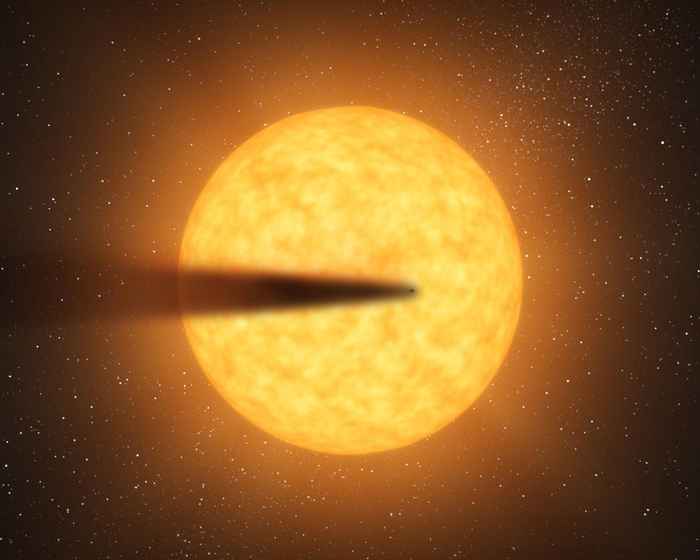
TOI-2431 b is about one and a half times the size of Earth, but orbits its star in an extremely close orbit. At a distance of only a few million kilometers—a few percent of the distance between Earth and the Sun—it completes one orbit in just over five hours. In doing so, it moves at a speed of over a million kilometers per hour. The nearby star heats the planet's surface to more than 2,000 degrees Celsius: TOI-2431 b is a so-called lava world. It belongs to a rare class of ultra-short-period planets: worlds that orbit their star in less than one day. Only a handful of these extreme systems are known.
Deformed shape
Because the planet is so close to its star, it is stretched by the strong gravity. Instead of being spherical, it is presumably slightly deformed, similar to a roasted almond. Moreover, the planet is located just above the so-called Roche limit, the boundary at which a planet can be torn apart by gravitational forces. Taş and his colleagues expect that, as a result, the planet is slowly spiraling towards its star. On a timescale of tens of millions of years (a blink of an eye in the life of a star), the planet comes so close that it is torn apart and eventually absorbed into the star. “The planet we have found is very special and exceptional,” says Taş. “We seem to be seeing it just before it comes to an end.”
Special software
The discovery began as a student project. Together with fellow students Syarief Fariz and Esha Garg, Taş wrote an observation proposal for the Mercator telescope on La Palma to investigate the star TOI-2431 further. In data from NASA’s TESS Space Telescope, this star had already been marked as a possible planet candidate, but the signal had not yet been confirmed. The extremely short orbital period and uncertain previous estimates made it a difficult system that required targeted follow-up observations.
For the analysis, Taş developed his own software, ExoMUSE, with which he could model transit and radial velocity data together. With additional observations from two American telescopes, the team was subsequently able to confirm the planet's existence and determine its properties.
Rare measurements
That combination of observations made it possible to accurately determine both the size and mass of the planet. Such two independent measurements are rare for small exoplanets, and certainly for planets with such extremely short orbits. Together, they show that TOI-2431 b is a compact, rocky planet, approximately six times as massive as Earth.
Because the parent star is relatively bright, the planet is an interesting object for further research. With telescopes such as the James Webb Space Telescope, astronomers will be able to learn more in the future about the atmosphere and the distribution of heat across the surface of this extreme world.
Taş received the KHMW Young Talent Graduation Award for Astronomy for his master's thesis, which also incorporates the results of this research.